
Film Review 14th September 2026
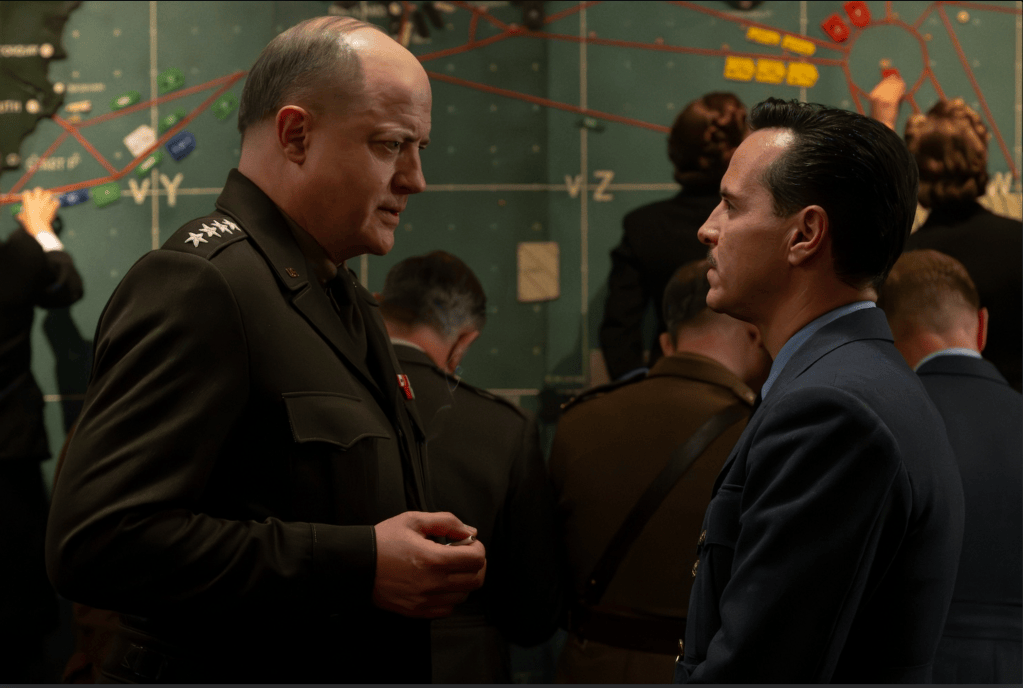
A film about a weather forecast might not sound particularly gripping. But when that forecast determines whether the D-Day invasion can go ahead, every change in the weather becomes a matter of life and death. Pressure takes a less familiar story from the Second World War and turns it into a tense, absorbing drama, anchored by a beautifully restrained performance from Andrew Scott.
Scott plays James Stagg, the Scottish meteorologist advising the Allied command ahead of the Normandy landings. The invasion is planned for 5 June 1944, but the conditions have to be right: moonlight for the airborne operation, suitable tides and seas calm enough for the landing craft. A storm could be catastrophic.
The film builds its central conflict around two competing forecasts. American meteorologist Irving Krick puts his faith in historical weather charts and believes the operation can proceed. Stagg, watching the weather developing over the Atlantic and the reports arriving from Ireland, sees a storm approaching. His job is to tell a room full of men preparing an enormous military operation precisely what they do not want to hear.
This is where the title earns its keep. There is atmospheric pressure, of course, but also the pressure of military responsibility, the pressure to provide certainty and the pressure of standing by an unwelcome conclusion. The commanders fear that a delay will cost them their opportunity and risk exposing their plans. Stagg fears what will happen if they go ahead. Everyone’s blood pressure seems to rise.
Scott is particularly good at making that strain visible beneath Stagg’s reserve. His performance is quiet and contained, but you can feel how much it costs this man to keep his composure. He has expertise, yet he cannot offer a guarantee. The generals want a definite answer from something as stubbornly uncertain as the British weather.
There is personal pressure, too. Stagg’s wife is expecting a baby, and he is unable to keep in touch as the birth approaches. When her hospital is bombed, uncertainty about her safety adds another layer of anxiety. This is also where the film’s determination to raise the stakes becomes most obvious. The pregnancy was real; the hospital bombing was invented. It is an effective dramatic device, although the central dilemma hardly needs more tension. Sky HISTORY’s factual account
There is a lovely connection behind the camera: one of the assistant editors working through the archival footage was Stagg’s grandson, also named James Stagg. The discovery was the production’s family connection, rather than a researcher finding out who his own grandfather was. Anthony Maras interview
As with many films based on historical events, Pressure simplifies a more complicated story. Stagg’s forecast drew on the work of several meteorological teams, and the film sharpens their disagreements into a more personal confrontation. The broad historical story remains: the weather forced a postponement, and a brief improvement allowed the invasion to proceed on 6 June. Smithsonian’s historical account
Those liberties are worth acknowledging, but they do not undo what works here. This is a gripping, well-acted drama that gives welcome attention to an often overlooked part of D-Day. We know when the landings happened, yet the film still makes us feel the uncertainty of the people who had to decide. It is not a documentary, and it occasionally pushes its title’s theme a little hard. But Scott’s restraint holds it together: a quiet man, an unwelcome forecast and an almost unbearable weight of responsibility.
| Film | Pressure |
| Release Date | 9 September 2026 (UK) |
| Platform | Cinema |
| Director | Anthony Maras |
| Running Time | 100 minutes |
| Film Link | Pressure Official Website |
| Cast | Andrew Scott, Brendan Fraser, Kerry Condon, Chris Messina, Damian Lewis, Tamsin Topolski, Jojo Macari, Con O’Neill, Alexander Hanson, Robert Portal, and Harrison Osterfield |
 Wolfe in the Wings
Leave a comment