Soho Theatre Review 8th October 2026
There are few television writers whose careers have been quite as influential, or as gloriously varied, as Russell T Davies. From children’s television to Queer as Folk, Doctor Who and It’s a Sin, his work has helped shape British television, particularly when it comes to bringing LGBTQ+ lives and stories into the mainstream.
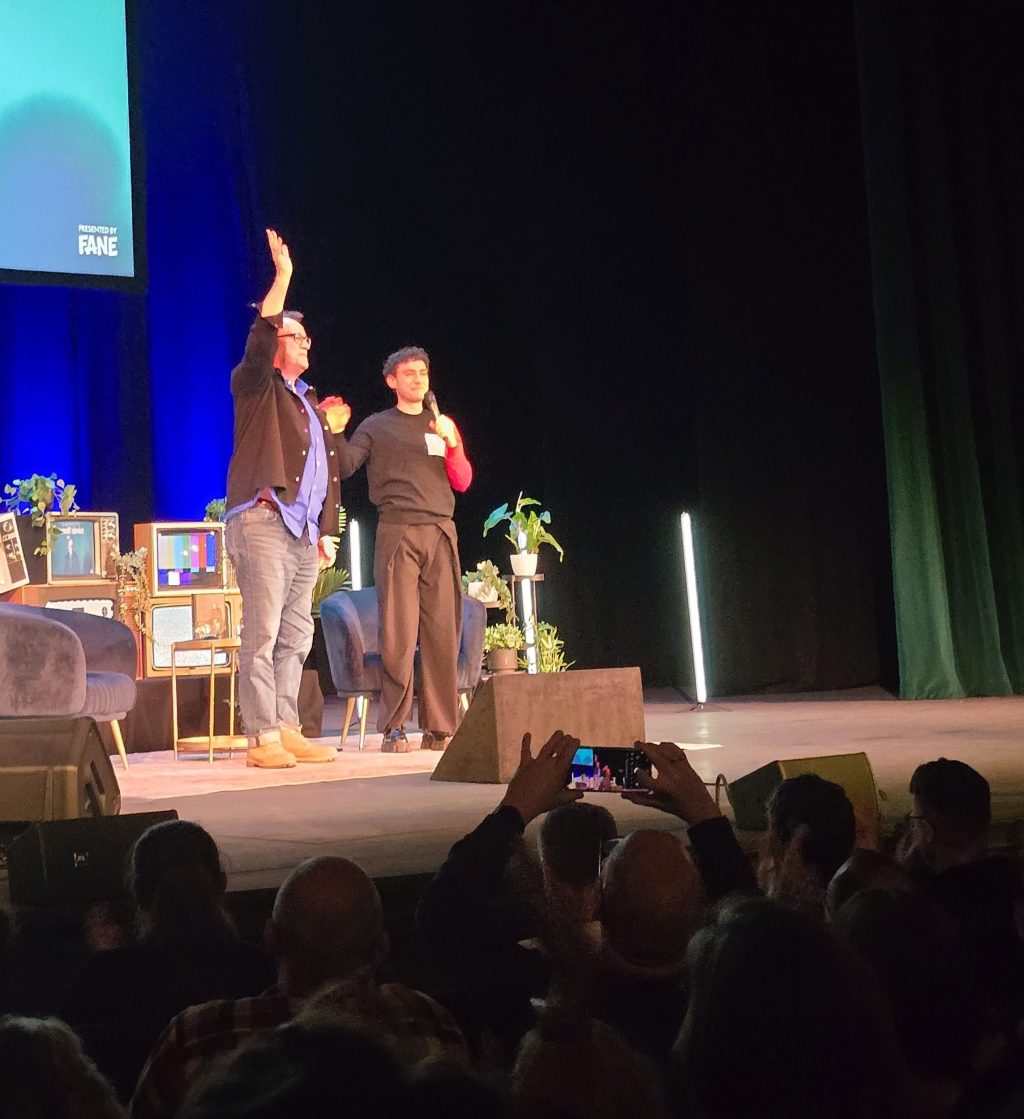
With the publication of his new book, The Queerest of Folk, Davies takes to the stage for an evening of conversation with actor and musician Olly Alexander, who starred in his acclaimed drama It’s a Sin.
Having only received my copy of the book at the event, I can’t comment on its contents beyond what was shared on stage. This is very much a review of the conversation itself.
Davies opens with a reading from the book, recounting an encounter with the legendary Peter O’Toole during the filming of Casanova, the 2005 television drama starring David Tennant, whose performance would help lead to his casting as the Tenth Doctor.
Before launching into the story, Davies warns us about the language and asks whether there are any children in the audience, before adding, “Apart from my boyfriend.” It’s a cheeky opening that immediately establishes the tone of the evening.
It turns out O’Toole was absolutely furious with Davies over changes to a script whose lines he had already painstakingly learnt. The resulting torrent of obscenities is hilariously punctuated by the sound of a bicycle horn, effectively bleeping out the worst of the language. Davies reflects that there was a valuable lesson to be learnt about the difficulties an older actor might face when suddenly confronted with new dialogue.
It’s a wonderfully entertaining way to begin the evening, combining Davies’ natural storytelling ability with a healthy dose of theatrical comedy.
Olly Alexander then takes us back to the beginning of Davies’ career, when getting a job at the BBC could apparently be achieved by simply writing to the personnel department, or HR as we would call it today.
Davies talks about his early work in children’s television and discovering that, once a programme became successful, he could begin experimenting with its format. It was an early opportunity to develop the confidence and creative freedom that would become such recognisable features of his writing.
His move to Granada Television led to further opportunities, and eventually to the realisation that he was becoming rather good at writing gay characters. At a time when LGBTQ+ lives were still largely absent from mainstream television, this would prove particularly significant.
The result was Queer as Folk, the groundbreaking Channel 4 series that arrived in 1999 and changed the landscape of British television.
Davies recalls a press screening attended by around 250 journalists. According to him, 249 hated it. The complaints were familiar ones: it went too far, it was outrageous, and it failed to deliver the safe-sex messaging some critics apparently expected from a drama featuring gay men.
But one journalist, Boyd Hilton of Heat magazine, loved it. Davies speaks warmly of Hilton’s support and acknowledges how much he owes him.
It’s a fascinating reminder of just how controversial Queer as Folk was at the time, and how easily we can forget the resistance faced by programmes that subsequently become recognised as cultural landmarks.
Davies also reflects on how television production has changed. During Queer as Folk, intimacy coordinators, now employed to help ensure actors feel safe and supported during intimate scenes, simply weren’t part of the process. Davies recalls being drafted in to help with such matters himself, although quite what that involved remains amusingly unclear.
For aspiring writers, Davies offers some refreshingly straightforward advice: listen to people.
He explains that he remembers conversations from throughout his life, often using something someone has said as the starting point for a scene or character. It’s a deceptively simple insight into how a writer can transform ordinary human exchanges into compelling television.
Inevitably, Doctor Who enters the conversation. Davies touches on how his involvement began around 1999, although the subject receives surprisingly little attention considering its enormous place in his career.
He does, however, single out Donna Noble, played by Catherine Tate, as a particular favourite, praising Tate’s acting and her extraordinary command of language.
It’s a lovely reminder that Davies’ writing is not simply about grand ideas or dramatic situations. He clearly delights in the way characters speak, and in finding actors capable of bringing those words vividly to life.
We also discover what he’s currently enjoying on television, with Heated Rivalry and Ann Droid among his favourites.
Perhaps one of the evening’s more unexpected diversions is a remarkable family story involving the secret services and spies. Davies tells us this particular tale isn’t in the book, offering the audience something genuinely exclusive.
And therein lies both the pleasure and the slight frustration of the evening.
Davies has so many stories to tell that there simply isn’t enough time to explore them all. Subjects appear, fascinating anecdotes emerge, and before long we’re moving on to something else. Doctor Who alone could easily fill an entire evening, while Queer as Folk and It’s a Sin deserve equally substantial conversations.
Alexander proves a well-prepared interviewer, guiding Davies confidently through the various stages of his career. Their shared history on It’s a Sin gives the conversation a natural warmth, although there is a sense that the questions have been carefully rehearsed, with Alexander generally choosing to stay on safer ground.
The audience, seemingly a wonderfully geeky and predominantly queer gathering, is clearly appreciative. There is plenty here for devotees of Davies’ work to enjoy, from the early days of children’s television to the cultural impact of Queer as Folk and the occasional tantalising glimpse behind the scenes of Doctor Who.
A short audience Q&A follows, with questions submitted online in advance. However, even here, the conversation rarely ventures into particularly challenging territory. I had cheekily submitted a question asking how Davies felt about Disney, but sadly that one didn’t make the cut.
It’s a shame, because Davies is someone whose opinions on television, representation and the industry are often as interesting as the programmes he creates. A few more probing questions might have revealed something beyond the familiar career anecdotes.
Nevertheless, Davies is never less than entertaining. He’s funny, candid and clearly still fascinated by the craft of writing television. Whether recalling a furious Peter O’Toole, discussing the controversy surrounding Queer as Folk or explaining how overheard conversations become television dialogue, he has an infectious enthusiasm for storytelling.
Ultimately, it’s an entertaining evening that occasionally feels more like a carefully managed book launch than an opportunity to really get under the skin of one of Britain’s most influential television writers.
But Davies is such an engaging storyteller that even a relatively safe conversation proves thoroughly enjoyable.
And if the book contains even half as many entertaining stories as he manages to squeeze into this evening, I suspect I’ve got some very enjoyable reading ahead.
| Show | Russell T Davies: The Queerest of Folk |
| Dates & Times | Thursday, 8 October 2026 – London, Soho Theatre Walthamstow (with Olly Alexander) Friday, 9 October 2026 – Cheltenham, Cheltenham Literature Festival (with Boyd Hilton & Munroe Bergdorf) Saturday, 10 October 2026 – Brighton, Brighton Dome (with Will Young) Sunday, 11 October 2026 – Manchester, Royal Northern College of Music (with Bernardine Evaristo) Monday, 12 October 2026 – Barry, Memo Arts Centre (with Owain Wyn Evans) Tuesday, 13 October 2026 – Edinburgh, Assembly Roxy (presented by Lighthouse Bookshop) |
| Venue | Soho Theatre |
| Booking | Please search for the venues listed above |
Disclosure: I received a press ticket for this


Leave a comment